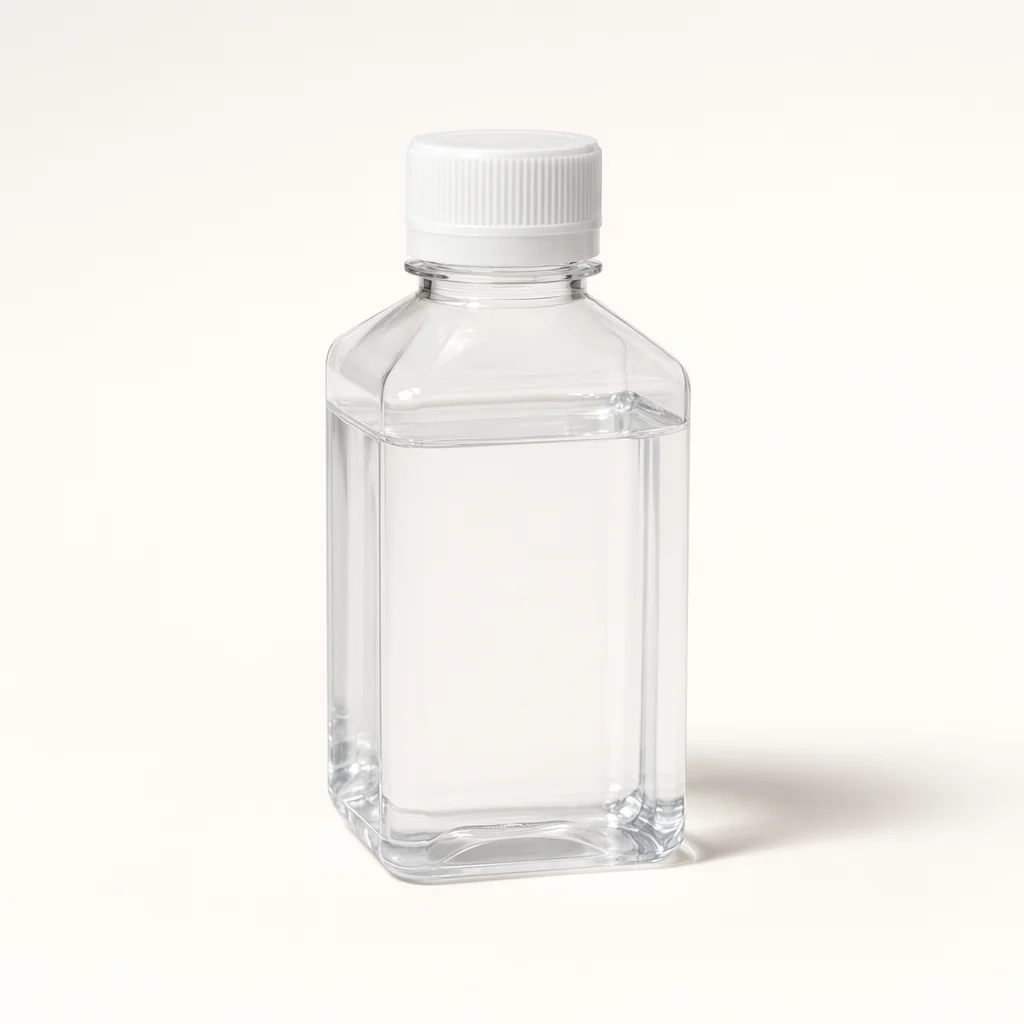
Calcium- and Magnesium-Free PBS pH 7.4
CCM-RG-0008 is a sterile, animal-origin-free phosphate-buffered saline solution at pH 7.4, supplied without calcium, magnesium, or phenol red. This 500 mL balanced salt solution is designed for routine cell culture washing, dilution, and handling workflows where divalent-cation-free PBS is specified. It is filter-sterilized, endotoxin controlled, and shipped at ambient temperature with shipping quoted per order.
- ✓ Manufacturer base price, shipping quoted per order
- ✓ ISO-aligned manufacturing
- ✓ Certificate of Analysis on request
- ✓ Bulk & custom volumes quoted on request
Overview
CCM-RG-0008 is a ready-to-use liquid phosphate-buffered saline formulated as a balanced salt solution for cell culture support operations. The product is supplied as 500 mL of PBS with a specified pH range of 7.3 to 7.5 and osmolality of 280 to 320 mOsmol/kg, supporting compatibility with common mammalian cell handling procedures. The formulation excludes phenol red, calcium ions, and magnesium ions, making it appropriate for protocols in which divalent cations may interfere with rinsing steps, cell detachment preparation, reagent dilution, or downstream analytical readouts.
The material is classified as animal-origin-free and filter-sterilized. Endotoxin is controlled at ≤1 EU/mL, supporting use in R&D, process development, and bioprocess support environments that require documented reagent specifications. As part of the CellCultureMedia cell culture reagents portfolio, this PBS is positioned for procurement teams standardizing routine buffer supply across academic, biotech, and biopharma laboratories. The list price is $9.44 per 500 mL unit; buyers planning recurring use, multi-site purchasing, or larger quantities may request a quote for current availability and volume pricing.
Applications
- Rinsing adherent cell monolayers before dissociation workflows where calcium- and magnesium-free PBS is specified.
- Washing suspension or adherent cells prior to counting, passaging, medium exchange, or sample preparation.
- Dilution of compatible cell culture reagents, provided the end-user protocol supports phosphate-buffered saline without divalent cations.
- Short handling steps requiring an isotonic balanced salt solution with pH 7.4 nominal conditions.
- Preparation of control blanks, wash fractions, or buffer-only process steps in non-phenol-red workflows.
- General laboratory standardization where animal-origin-free, sterile PBS with defined endotoxin, osmolality, and shelf-life specifications is required.
Storage and Handling
Store CCM-RG-0008 at 2 to 30 °C protected from light. The product ships at ambient temperature and does not require frozen transport under the stated shipping conditions. Keep the bottle closed when not in use, use aseptic technique during dispensing, and avoid repeated exposure to non-sterile environments. The stated shelf life is 48 months when stored as directed in the unopened container. Do not use material that shows visible contamination, leakage, precipitation outside expected appearance, or a compromised closure. For process-controlled laboratories, record lot number, opening date, storage location, and in-use period according to site procedures.
Quality and Documentation
CCM-RG-0008 is supplied to specification for pH, osmolality, sterility by filtration, endotoxin limit, formulation exclusions, and storage conditions. CellCultureMedia supports procurement and technical review with lot-specific documentation where available, including Certificate of Analysis on request. Our quality approach is designed for ISO-aligned supplier qualification, incoming inspection, and controlled laboratory purchasing; additional information is available through our quality documentation resources. Shipping is quoted per order and destination; wholesale quantities ship most economically.
Specifications
Formulation Highlights
Does Not Contain (-)
Phenol red, Ca 2+, Mg 2+
Storage & Handling
Storage: 2~30 ℃, protected from light. Shelf life: 48 months. Ship cold-chain where required.
Quality & Documentation
Manufactured under ISO-aligned quality management systems. Full documentation — Certificate of Analysis (CoA), Material Safety Data Sheet (MSDS), formulation summary, and stability data — is available on request. Email [email protected] with the SKU.
About this product
What cell lines does this product support?
How is this product shipped?
Is a Certificate of Analysis available?
What is the typical lead time?
Do you offer bulk pricing?
Learn more about this
- PBS vs DPBS: What Is Different, and Which One to UsePBS and DPBS are both phosphate-buffered saline solutions; the difference is the recipe, not the function. Dulbecco's formulation (DPBS) adds potassium chloride and carries roughly twice the phosphate of a typical PBS (about 9.5 mM versus about 4 mM), and it is sold in two versions - with calcium and magnesium, and without. In practice the with-or-without-divalent-cations choice matters far more than the PBS-or-DPBS label: use a calcium- and magnesium-free solution to wash cells before trypsinisation or EDTA dissociation, because Ca2+ and Mg2+ support the cadherin and integrin bonds you are about to break, and use the version containing calcium and magnesium when cells must stay attached and intact through the wash.
- Cell culture buffersCell culture buffers hold medium in the pH 7.2-7.4 range that mammalian cells require, against the acid load cells generate as they metabolise. The default system in almost every classical medium is sodium bicarbonate working with the CO2 in the incubator atmosphere, which is why bicarbonate content must be matched to the incubator setting: about 1.5-2.2 g/L NaHCO3 for 5% CO2 and 3.7 g/L for 10% CO2. Organic buffers such as HEPES (pKa 7.48) are added at 10-25 mM to hold pH when cultures are outside a CO2 atmosphere, while phosphate-buffered solutions such as PBS and DPBS are used for washing and short-term handling rather than for growth.
- Poly-L-Lysine Coating for Cell CulturePoly-L-lysine coating covers a culture surface with a positively charged synthetic polymer that binds the negatively charged plasma membrane, allowing weakly adherent cells to attach to glass or plastic. The standard protocol applies a sterile 0.01% (0.1 mg/mL) solution at roughly 1 mL per 25 cm2, leaves it in contact with the surface for 5 minutes to 1 hour at room temperature, aspirates, rinses thoroughly with sterile tissue-culture-grade water, and air-dries the surface for at least 2 hours before cells are seeded. The attachment it provides is purely electrostatic: poly-L-lysine does not engage integrins, so cells that need genuine extracellular matrix signalling require laminin, fibronectin or collagen instead of it or on top of it.